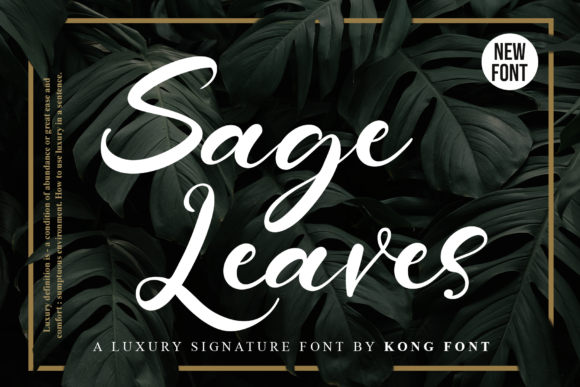
The Unfolding Beauty of Sage Leaves: A Font for Meaningful Design
There’s a certain warmth that comes with a handwritten note, a quality that feels both personal and intentional. In the digital realm, where crisp, uniform typefaces often dominate, capturing that organic, human touch can be a powerful differentiator. This is where a typeface like Sage Leaves enters the conversation. Created by Kong Font Studio, this modern script font isn't just a collection of letters; it's a design tool built to inject personality, approachability, and a distinct handwritten charm into a wide array of creative projects. For designers, crafters, and entrepreneurs, understanding how to leverage such a font can be the key to creating work that resonates on a deeper, more emotional level.
A Script with a Modern, Playful Soul
At its core, Sage Leaves is a premium font that balances fluidity with readability. It’s a handwritten font, but it avoids the pitfalls of being overly casual or difficult to decipher. The letterforms have a consistent, modern flow, with elegant connections and a playful bounce that gives text a lively rhythm. This isn't a font that mimics shaky, hurried writing; instead, it presents a polished, intentional script that feels both personal and professional. Its visual appeal lies in this duality—it’s friendly enough for a greeting card yet stylish enough for a boutique logo. When you’re choosing a typeface for a project, the personality it conveys is paramount. Sage Leaves speaks a language of warmth, creativity, and authenticity.
From Brand Identity to Wedding Invitations: Real-World Applications
The true test of any creative font is its versatility. Where does a script like Sage Leaves truly shine? Its applications are surprisingly broad, making it a valuable asset in any designer's toolkit.
- Branding and Logo Design: For businesses that want to appear approachable, artisanal, or service-oriented, Sage Leaves can form the heart of a brand identity. Imagine it used for a bakery logo, a boutique consulting firm, or a handmade skincare line. It instantly communicates care and a personal touch, helping with brand recognition by creating a memorable, human-centric visual mark.
- Packaging and Product Design: On physical goods, typography is tactile. Using Sage Leaves on packaging design for coffee bags, candle labels, or artisanal food products can elevate the unboxing experience. It suggests the product inside is crafted with thought, enhancing its perceived value and encouraging customer engagement.
- Digital Presence and Marketing: In the fast-scrolling world of social media, a script font can stop the thumb. Sage Leaves is perfect for social media graphics, Instagram story quotes, and YouTube thumbnails. On a website, it can be used sparingly for headlines or call-to-action buttons to draw the eye, adding a layer of personality to web design that sans-serif fonts alone can't achieve. It’s equally effective in email marketing headers and digital ad copy.
- Print and Editorial Layouts: The font isn't limited to digital use. It brings elegance to editorial design in magazine pull-quotes, chapter titles in self-published books, or feature headings in a blog layout. For print materials like business cards, brochures, and posters, it offers a sophisticated alternative to standard script fonts, ensuring a professional presentation that feels custom and unique.
- Events and Personal Projects: This is where the font feels most at home. Wedding invitations, save-the-dates, thank you cards, and event signage are transformed by its graceful curves. For crafters designing printable wall art, planners, or greeting cards, it provides that sought-after, high-quality handwritten look without needing to perfect your own penmanship.
Pairing for Purpose and Ensuring Readability
A great display font rarely works in isolation. The art of font pairing is crucial for creating balanced, readable, and visually consistent designs. Sage Leaves, as a script font, has a strong personality, so it pairs best with more neutral companions.
For maximum contrast and readability, try combining it with a clean sans serif font for body text. Think of Sage Leaves for a hero headline on a website, followed by a font like Open Sans or Lato for the paragraph text. This hierarchy guides the reader's eye and maintains clarity. Alternatively, pairing it with a sturdy, traditional serif font like Garamond or Georgia can create a classic, elegant feel suitable for editorial layouts or formal invitations. The key is to let Sage Leaves be the star of the show in short bursts—headlines, logos, pull quotes—while allowing its partner font to handle the heavy lifting of long-form copy.
Before finalizing any design, always test your font choices at various sizes and in the context they’ll be viewed. A line of text that looks beautiful in a design mockup might become illegible when scaled down on a mobile screen or printed on a textured paper. Pay close attention to letter spacing and line height to ensure the text breathes and remains easy to read.
Practical Considerations for Your Project
When you incorporate a commercial font like Sage Leaves into a project, a few practical steps ensure a smooth process. First, review the full character set and any included font styles. Often, premium fonts come with alternate characters, ligatures, or stylistic sets that can add even more flair and customization to your designs. Exploring these options can help you avoid a "cookie-cutter" look and tailor the typography specifically to your project's needs.
Second, and critically, understand the licensing. As a commercial font available through platforms like Creative Fabrica, Sage Leaves comes with specific usage rights. Whether you're using it for a client's logo, on merchandise for sale, or in a digital product you distribute, ensure your license covers that application. This is a non-negotiable part of professional design work and protects both you and the font's creators.
Ultimately, a typeface like Sage Leaves is more than just a design asset; it's a bridge to your audience. It can help improve audience engagement by making your message feel more personal and less corporate. By thoughtfully integrating its modern, handwritten charm, you can create designs that are not only visually stunning but also genuinely connect with the people you're trying to reach. It’s a reminder that in design, the human touch is often the most powerful element of all.